Electronic Resource
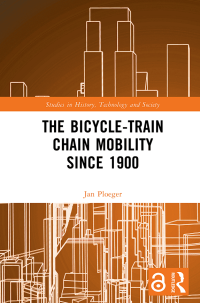
The Bicycle-Train Chain Mobility Since 1900
This book examines the historical development of bicycle and train integration as a sustainable alternative to car-dependent transportation, with a particular focus on the Netherlands since the early twentieth century. It explores the concept of chain mobility, which connects cycling, walking, and rail transport to provide seamless and efficient journeys. The book analyzes the roles of cyclists, advocacy organizations, urban planners, policymakers, and Dutch Railways in developing the infrastructure and services needed to integrate bicycles and trains. Key topics include bicycle parking facilities at railway stations, bicycle rental services, transit-oriented development (TOD), spatial planning, and the evolution of the OV-fiets public bicycle-sharing system. It also discusses the challenges of coordinating different transportation modes and the importance of improving accessibility and connections between the beginning and end of a journey. Drawing on historical research, urban planning, and science and technology studies, the book demonstrates how social practices, institutional cooperation, and technological innovation contribute to sustainable mobility. It provides valuable insights for researchers, transportation planners, policymakers, and professionals interested in multimodal transportation, railway development, cycling infrastructure, and sustainable transport systems.
Availability
Detail Information
- Series Title
-
-
- Call Number
-
388.04209 PLO t
- Publisher
- Oxford : Routledge., 2026
- Collation
-
E-book
- Language
-
English
- ISBN/ISSN
-
97-1003705406
- Classification
-
388.04209
- Content Type
-
text
- Media Type
-
computer
- Carrier Type
-
online resource
- Edition
-
Cetakan pertama, 2026
- Subject(s)
- Specific Detail Info
-
-
- Statement of Responsibility
-
Penulis, Jan Ploeger.
Other version/related
No other version available
File Attachment
Comments
You must be logged in to post a comment
 Computer Science, Information & General Works
  Philosophy & Psychology
  Religion
  Social Sciences
  Language
  Pure Science
  Applied Sciences
  Art & Recreation
  Literature
  History & Geography